
On 6 and 7 November 2026, protests will take place across Europe to oppose polluting, hyperscale data centres. This issue affects many countries, but not Italy at present.
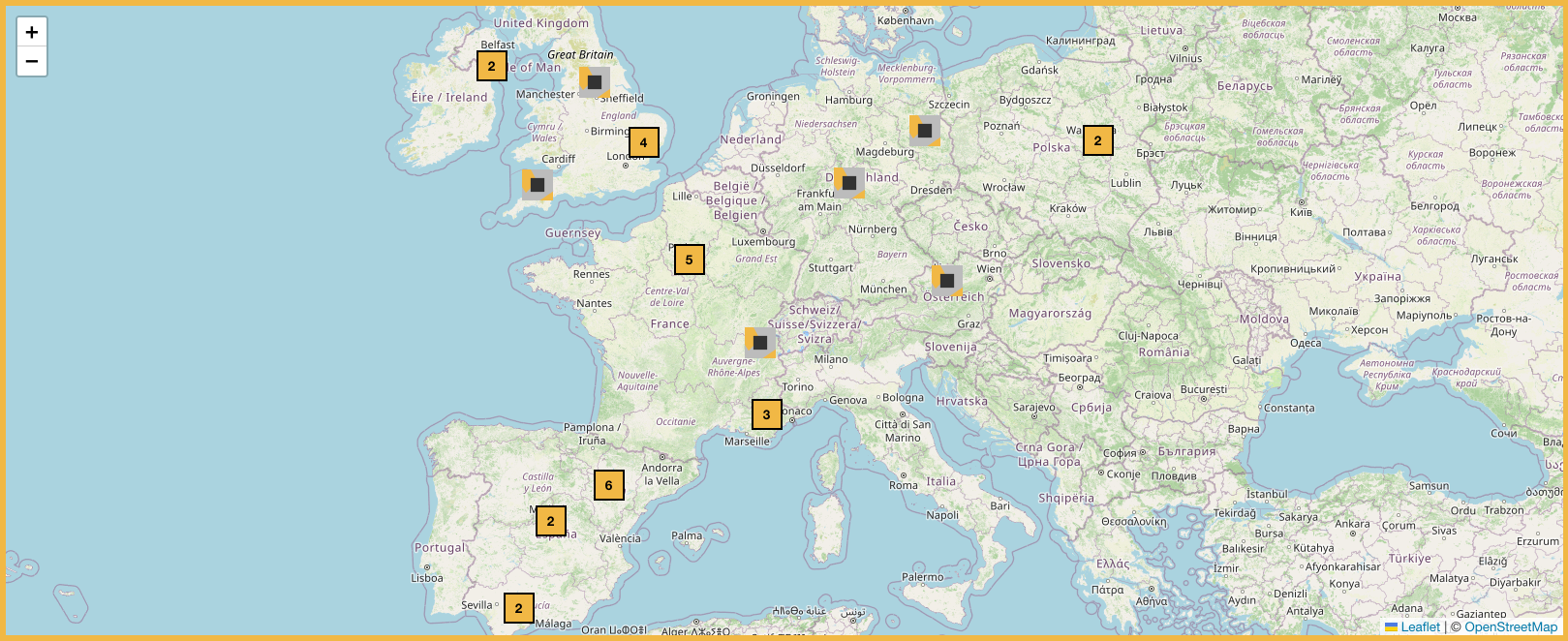
With regard to the map published on the Stop Dirty Data Centres website, the following is taken from the portal:
The information contained in this map is provided to us by third parties and is published for information purposes only. StopDirtyDataCentres.EU accepts no responsibility for the events listed, any errors in the information, or any action taken on the basis of this information. StopDirtyDataCentres.EU supports non-violence and believes in people’s democratic right to express their opinions, assemble and protest.
The list of supporters is very extensive and can be viewed below:
Click to expand the list of supporters
Water and Life
An Taisce
APRS Scotland
Araba Bizirik
Art and Ethics • Artivism and Spanish-speaking authors
Ban Data Centres in Epping Forest
BOLD Climate Action
Bürger:innen Initiative Rechenzentrem Kronstorf (Citizens’ Initiative: Kronstorf Data Centre)
UNESCO International Chair in Sustainable Human Development
Climate Justice Universities Union
Barcelona Permacomputing Club
Common Ecologies
Alcalá de Henares Anarcho-Syndicalist Confederation
CGT IT Co-ordinating Committee
Corporate Europe Observatory
Critical Infrastructure Lab
Cymru’n Codi
Data 4 Good
The Green Youth Movement
Devon Data Centre & BESS Action Group
dyne.org
Ecologistas en Acción Guadalajara
Ecologistes en Acció de Catalunya
elii [architecture practice]
Environmental Law Foundation
Equinox Initiative for Racial Justice
Extinction Rebellion Bristol – https://xrbristol.org.uk/
FIBER Festival
The People’s Movement to Stop Data Centres
Fossielvrij Netherlands
Foxglove
Friends of the Earth Denmark
Friends of the Earth Dundalk
Friends of the Earth England, Wales and Northern Ireland
Friends of the Earth Europe
Friends of the Earth Ireland
Friends of the Earth Scotland
“Mission Possible” Foundation
GLOBAL 2000
Global Action Plan
Global Justice Now
Green Tech South West
Green Web Foundation
Greenpeace Germany
GRÜNE LIGA e.V.
Gure Haizea
House of Annetta
Institute for Postnatural Studies
Iver Heath Residents’ Association
La Campiña Verde
Leitmotiv
London Permacomputing Club
National Women’s Council of Ireland
Nijjor Manush
Nina – Norwegian Institute for Nature Research
It’s not a drought, it’s plunder
No Leeds Data Centre Campaign
No Leeds Data Centre Campaign
No to the East Havering Data Centre
Not Here, Not Anywhere
Iberian Energy Observatory
Pangea.org
People vs Big Tech
Permacomputing wiki
Podemos Alcalá de Henares
Podemos Fuenlabrada
Privacy Network
Centre for Racism and Technology
Eco-Socialist Network
Let’s Save the Venice Pine Forests
SOMO
Spanish Strategic Litigation Group
Stop Climate Chaos (Ireland)
STOP the Piaseczno Data Centre
Association of Active Neighbours (SAS)
TITiPI (The Institute for Technology in the Public Interest)
Your Dry Cloud, My River
University of Paderborn
Waag Futurelab
XR Namur
Zuloark
The website mentions a wide range of “creative initiatives aimed at raising awareness of the various reasons for opposing the uncontrolled expansion of AI data centres”. Documents have also been made available to provide further details on how to get involved. For further information on the reasons behind this event and, more generally, behind this movement, please refer to the following document.
The following are some of the most important statements on the subject, translated into Italian from English.
Owen Espley, coordinator of StopDirtyDataCentres.eu, said:
‘Communities across Europe are protesting against the imposition of data centres that consume vast amounts of energy, water and land on their territories. By joining forces, campaigns waging a David-versus-Goliath battle against tech multinationals — all too often backed by policy-makers — are proving they have the power to halt the rush to build data centres. They are calling on political leaders to impose moratoriums on large-scale data centres at European, national and local levels, so that their concerns are addressed and the impact of such infrastructure is properly assessed.”
Rosi Leonard, head of the data centre campaign for Friends of the Earth Ireland, said:
‘The massive expansion of data centres is taking a toll on communities in Ireland that we can no longer afford. We are witnessing the construction of data centres accompanied by a massive expansion of fossil gas; we see them driving up our bills; we see how they are diverting public spending and clean energy away from climate action and genuine energy security. We are proud to join forces with other countries across Europe to demand better for our communities and say ‘enough is enough’ to Big Tech’s power grab.”
Niamh Fitzgibbon, from Data Centre Awareness Kildare (Ireland), said:
‘This is about our land, our water, our electricity and our health. Groups everywhere are facing uncontrolled, large-scale data centre development. All too often, each community fights this battle on its own, but the problems are the same everywhere, from Kildare to the rest of the world. Today we stand united, and if our elected representatives do not represent us, we will represent ourselves.”
Oliver Hayes, head of campaigns at Global Action Plan (UK), said:
“Data centre developers in the UK and across Europe want to capitalise on the AI gold rush, regardless of the consequences. But communities everywhere are fighting back. From people in central London to the hills of Devon, citizens are united in their resistance, exposing Big Tech’s propaganda machine and calling a spade a spade: a massive land-grab by Silicon Valley billionaires for scarce resources such as land, water and energy. With governments failing to answer fundamental questions about how many data centres we need, for what purpose, where they will be built and how pollution will be prevented, the only sensible option is an immediate moratorium.”
And what about Italy?
A document setting out objections to an amendment to a Lombardy Regional Law on data centres was recently submitted; the document was handed over by Maria Grazia Bonfante (Chair of TERRE NOSTRE National Coordination for Health and the Environment) and Enrico Duranti (Chair of the Ciarlasco Committee for the Protection of the Territory).
The objections can be summarised as follows.
The illegality of exemptions from the ban on water consumption
- Use of contaminated water: The regional law introduces an exemption allowing data centres to be cooled using contaminated water (subject to subsequent treatment). The committees argue that this contravenes Legislative Decree 152/2006 (Environmental Code), on the grounds that treating water used in an industrial cycle does not amount to remediating the groundwater table, nor does it guarantee that pollutants (such as PFAS) will not be released or that emissions will not be released into the atmosphere.
- Exception for ‘high water efficiency’: The exemption for high-water-efficiency systems, which is not subject to quantitative limits, risks undermining the general ban on water consumption, as it fails to take into account water shortages and the high climate vulnerability of Lombardy’s agricultural sector.
Failure to assess total and cumulative water consumption
- It is argued that the law only takes into account the water used for cooling and not the infrastructure’s total water requirements.
- There is a lack of adequate assessment of the cumulative impacts on reservoir availability, taking into account the combined consumption of data centres and other facilities (e.g. biomethane plants, agricultural and domestic uses).
Artificial splitting of projects
- Criticism has been levelled at the absence of a formal ban on the splitting of projects (e.g. dividing data centres into several lots/modules of less than 50 MW or separating energy infrastructure such as photovoltaic systems and BESS).
- This ploy enables the proponents to circumvent the impact thresholds and the mandatory procedures for EIA (Environmental Impact Assessment), SEA and state authorisation.
Usurpation of municipal planning autonomy
- There are objections to the automatic classification of data centres with a capacity of over 5 MW as ‘industrial’, as this creates an automatic presumption of compliance with town planning regulations in local authorities where the General Town Plan (PGT) designates industrial areas.
- This risks undermining the planning powers of local authorities. It is reiterated that amendments to town planning regulations must remain a discretionary decision of the local authority, based on the local public interest.
Surface energy sustainability and a lack of coordination with the PREAC
- Simply signing PPA contracts or Guarantees of Origin (for renewable energy) does not guarantee genuine sustainability (as there is no verification that production and actual consumption take place simultaneously).
- Criticism has been levelled at the rule which deems the mere submission of a power station design to be sufficient for the connection to be deemed suitable.
- Criticism has been levelled at the failure to ensure consistency between the enormous electricity demand of data centres and regional (PREAC) and national (PNIEC) energy planning.
Heat loss, heat islands and atmospheric emissions
- The draft bill fails to take into account the impact of heat released into the environment by cooling systems.
- Under the specific microclimatic conditions of the Po Valley (stagnant air, temperature inversions, high levels of PM10 and ozone), continuous heat emissions can cause or exacerbate the ‘heat island’ effect and alter the dispersion of pollutants.
- There is a lack of guarantees and specific tests regarding the emissions from emergency generators (which are often diesel-powered).
Belated transparency and limited public participation
- It is alleged that there has been a lack of prior information provided to members of the public and neighbouring local authorities from the outset of the preliminary investigation phase, in breach of the principles of the Aarhus Convention.
Excessive protection of the transitional arrangements for pending applications
- It is considered unfair and unreasonable to apply the new safeguards and requirements solely to projects submitted after the law came into force, thereby excluding all pending proceedings and applications that have not yet been concluded.
In this regard, the proposed amendments requested by the committees can be summarised in these six points:
- An absolute ban on the use of water for cooling and a strict prohibition on the use of contaminated water.
- Requirement to carry out a comprehensive water balance assessment and to verify compatibility with the catchment area prior to the issue of permits.
- An explicit ban on artificial fragmentation for all modules and associated infrastructure, with power output and impacts calculated on a cumulative basis.
- Safeguarding the autonomy of local authorities, whilst confirming that the approval of amendments to the General Town Plan remains a discretionary decision in the public interest.
- The proposer is required to submit a report on thermal impact, including an independent assessment and opinion from ARPA Lombardia on heat islands and air quality.
- Application of the new regulations to ongoing (as yet uncompleted) proceedings and the launch of retrospective checks and inspections on installations that have already been approved or are under construction.
We recommend reading the full text, which can be downloaded here.
